













































 Norway
One to one English for learners in Norway
You already speak English. Let's make it carry you further.
Work with one tutor who knows your goal, online on a video call or at home wherever a vetted tutor is available near you, and turn everyday English into English that holds up in meetings, essays and exams.

Your week, Europe/Oslo time
Wed19:30
Sat08:00
Sun10:00
A country that already talks in English and wants it sharper
If you went to school in Norway, English was most likely part of your timetable from the early years; under the former national curriculum it was scheduled from year 1. A figure cited from 2013 put the number of people in Norway who could converse in English to some extent at about 4.5 million, roughly 88 percent of the population. That is a remarkable base to build on, and it changes what a tutor is for. For many learners here the goal is the next step up: English that stays steady in a negotiation, an academic essay that reads as if it belongs in a journal, a presentation where the humor lands, or a job interview where nerves leave your sentences intact.
Norwegian sits close to English, which helps a great deal and occasionally misleads. Norwegian, Swedish and Danish form a continuum of more or less mutually intelligible varieties, while English and German are similar to Norwegian without being mutually intelligible with it. That closeness means you are likely to recognize a lot of English vocabulary on sight. It also means some words and structures feel familiar and then behave differently, the kind of quiet mismatch that even confident speakers carry for years without anyone pointing it out.
There is a cultural advantage too. Most Norwegians speak their own dialect in every setting, and any dialect counts as correct spoken Norwegian, so you are used to hearing many accents and following them with ease. You also grew up with two written standards side by side, Bokmål and Nynorsk, with about 15 percent of schoolchildren taught Nynorsk as their written language, and Sámi is an official language as well. That comfort with variety is a real asset in English, a language spoken with countless accents around the world. Our lessons build on it, with one aim: clear, confident English in your own voice, polished to the level your next step asks for.

Who books a private English tutor in Norway
You might recognize yourself in one of a few familiar pictures. One is the Norwegian professional whose English is fine in daily life and starts to wobble under pressure: a board presentation, a contract call with a partner abroad, a written report that will be read in another country. Another is the student heading into an English-taught degree or a master's abroad, who needs academic writing that persuades and, often, a test score on paper. A third is the adult who used English at school, drifted away from it, and now wants the confidence back.
Norway is also home to a large and varied immigrant community, and its workplaces bring together people with many different first languages. On 1 January 2024 the country counted 931,081 immigrants, about 16.8 percent of the population, and including Norwegian-born children of two immigrant parents the share with an immigrant background reached 20.8 percent. The largest birth countries that year were Poland, Ukraine, Lithuania, Syria and Sweden, so workplaces and neighborhoods bring together a wide range of first languages.
In Stavanger, about 22.1 percent of residents have an immigrant background, and the city hosts a NATO military command alongside branches of foreign energy firms. In a mixed working community like that, clear and professional English can help people get work done together. Whichever group you belong to, the lessons start from your goal and your current level, and your tutor shapes every session around the situations you actually face.
- Professionals who want precise, relaxed English for meetings, email and presentations
- Students preparing for English-taught programs at home or a degree abroad
- Newcomers to Norway who rely on English as a shared language at work
- Children and teenagers who want extra speaking practice, often booked by a parent or guardian
- Adults coming back to English after years away
Energy, shipping and seafood: where Norwegian work meets English
Norway's economy leans on industries that sell to the world and work with foreign partners every day. In 2024 petroleum made up about 60 percent of the country's export revenue and roughly 17 percent of GDP, and as of 2020 about 20 percent of Europe's natural gas came from Norway. Those figures tie the energy sector closely to customers and partners across Europe, and that link can show up in daily work as technical documents, safety briefings, supplier calls and contract negotiations.
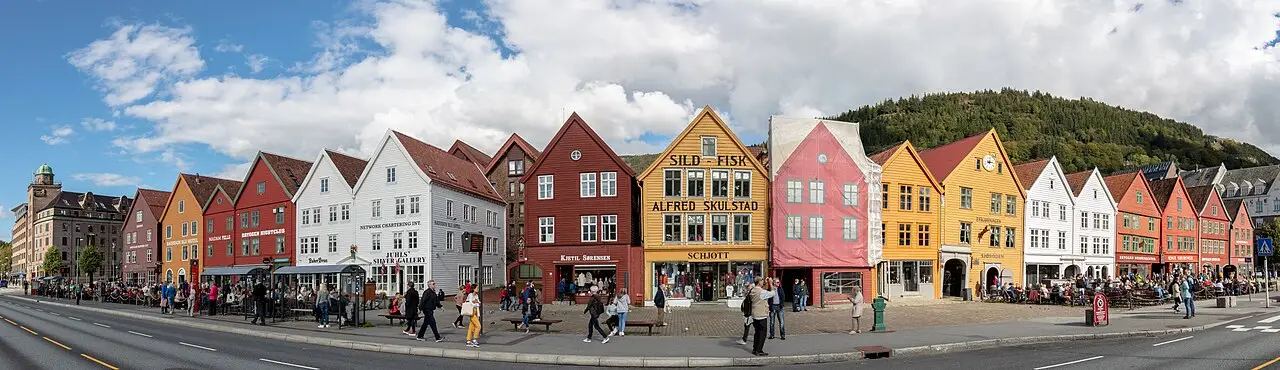
The list of main industries runs long: petroleum and natural gas, shipping, fishing, aquaculture, food processing, shipbuilding, metals and chemicals, with petroleum products, machinery, metals, chemicals, ships and fish as the main export goods. Bergen is described as an international center for aquaculture, shipping, the offshore petroleum industry and subsea technology, and its port is the busiest in Norway for both freight and passengers. Each of those fields has its own English, from vessel specifications and port logistics to subsea engineering terms and the careful wording of food safety documents.
A tutor who works with you on this goes well past vocabulary lists. Together you gather the documents and moments you actually face, then rehearse them until they feel ordinary: explaining a delay to a client, walking a visitor through a site, writing an incident summary that is short and unambiguous, or answering a technical question from someone whose English is also a second language. From the first week, the practice time feeds straight back into your job.
- Technical English for engineering, offshore and subsea roles
- Maritime and logistics English for shipping and port work
- Commercial English for seafood, aquaculture and export sales
- Clear report and email writing for regulated industries
English for meetings with Norway's biggest trading partners
Look at where Norway sells and the case for strong English becomes concrete. In 2023 the largest export partners were the United Kingdom and Germany at 19 percent each, followed by the Netherlands at 8.3 percent, Sweden at 7.7 percent, Poland at 6.1 percent and France at 5.9 percent. With a British partner you are working in their first language, at their speed and with their idioms. With German, Dutch, Polish or French partners, English is often the meeting point for both sides, and then the person who speaks most clearly tends to steer the conversation.
Oslo shows the same pattern at home. Its economy rests on trade, banking, industry and shipping, many maritime firms are based there, and it is the seat of national government. In offices like these, English turns up in board papers, investor updates, procurement documents and the conference call that runs over time because nobody wanted to interrupt.
Lessons for work start with a short map of your week. Your tutor asks which meetings, documents and conversations matter most, then builds sessions around them, so you might spend one lesson rehearsing the opening of a quarterly review and the next tightening a proposal before it goes out. Business learners are addressed in a professional register throughout, and the feedback is practical: a phrase to open with, a structure for bad news, a cleaner way to disagree politely.
- Leading a meeting and summarizing decisions clearly at the end
- Writing email that is friendly, short and unmistakable
- Presenting results and handling questions you did not prepare for
- Negotiating calmly when the other side is also using a second language
- Small talk at dinners, conferences and site visits

The sounds and habits Norwegian speakers carry into English
Norwegian gives you a head start in English pronunciation, plus a few habits worth knowing about. Norwegian is a pitch accent language, with two distinct pitch patterns that separate otherwise identical words, such as bønder (farmers) and bønner (beans or prayers). That melody is part of what gives Norwegian its singing quality, and it can travel into English as a rise and fall that English listeners do not expect. In English, meaning leans on which syllable carries the stress and which word in the sentence gets the emphasis, so your tutor works on those patterns directly.
Vowels deserve attention too. Norwegian vowels come in short and long pairs, and unstressed e is a schwa, the relaxed 'uh' sound. That is helpful, because English uses the schwa constantly in weak syllables, like the first and last vowels of 'banana'. The r is another clue to where you grew up: it is a tap in eastern, central and northern dialects and uvular in western and southern ones. Neither is wrong in English conversation, and your tutor helps you choose a clear, comfortable r and use it consistently.
Then there are the near neighbors in vocabulary and grammar. English and Norwegian are similar without being mutually intelligible, so some words and patterns look like Norwegian and work a little differently. A good tutor notices them gently and repeatedly until the right form becomes automatic.
- Words that look familiar from Norwegian: your tutor checks what they mean in English before you rely on them
- Advice and information take no plural s in English
- Word stress that changes meaning, as in CONtract the noun and conTRACT the verb
- Sentence stress that puts the weight on the word carrying your main point
- The z sound in 'is' and 'was', and the two th sounds in 'think' and 'this'
Speaking first, polishing as you go
Every Britemy lesson puts you in conversation from the very first session. That suits many learners well, because understanding often runs ahead of what we comfortably say aloud, and that gap closes fastest when you talk. Your tutor lets you finish your thought, notes what could be sharper, and brings it back at the right moment, so your accuracy improves along the way while the conversation keeps moving.
Confidence in English usually lives in small moments: the pause before you answer a question in a meeting, the second-guessing over a preposition, the joke you decide to skip because you are unsure of the phrasing. Lessons work on exactly those moments. You rehearse real situations until they feel routine, then raise the difficulty a little, so each session ends with something you can say today that you could not say last week.
Speaking first also makes lessons feel like conversations between two people. You talk about your work, your studies, the news, a book you are reading, and the English you need grows out of what you actually want to say.
- Role plays drawn from your own meetings, interviews and presentations
- Short spoken summaries of articles you choose
- Corrections collected during the lesson and reviewed at the end
- Gradual steps up in speed, length and complexity
How English fits into Norwegian schooling and degrees
School in Norway is mandatory for all children aged 6 to 16, covering primary and lower secondary school, and upper secondary education is a statutory right. Public primary and lower secondary schooling is free of charge for Norwegian citizens, and the school year runs from mid-August to late June.
English has long had a steady place in the timetable. Under the former national English curriculum, since replaced, pupils had 138 teaching hours of English across years 1 to 4, 228 hours across years 5 to 7 and 222 hours across years 8 to 10, counted in 60 minute units. The Norwegian Directorate for Education and Training states that new subject curricula for primary, lower secondary and upper secondary education were in place from August 2020.
Upper secondary general programs usually last three years and most vocational programs last four. For students who continue to university, upper secondary English carries real weight: the English course of 140 hours, with a written and an oral exam, is accepted as proof of English for admission, so many school leavers need no separate test to study at home. Higher education follows the Bologna structure of a three year bachelor, a two year master and a three year PhD, across 10 public universities, 9 specialized universities and around two dozen university colleges, and public institutions enroll more than 90 percent of students.
A tutor is most useful at the transitions. The jump from school English to academic reading in the first year of a degree can be steep, and so can the step from bachelor assignments to a master's thesis that has to argue, cite and qualify its claims with discipline. One to one lessons give you a place to practice that register before it is graded.
Extra speaking time for children and teenagers
Norway treats extra help for younger pupils as a public responsibility. Municipalities must offer homework help under section 4-4 of the Education Act, and pupils choose for themselves whether to take part. Only about 3.3 percent of pupils attend private schools, which receive state grants set at 85 percent of the average cost per pupil in similar public schools. Put together, extra support for younger children is first a public service, and paid private tutoring is not the default route, so it tends to be added for a specific need.
Those reasons tend to be concrete. A teenager reads English well and freezes when asked to speak in front of the class. A child is moving abroad for a year or into an English-language school. A pupil wants to prepare calmly for the oral part of an English exam. A young reader simply loves English and wants more conversation time than a full classroom can give.
Lessons for children are lively and built around talk: stories, games, describing pictures, explaining a hobby, retelling a film. Teenagers work on the topics they care about and on the skills school will test, from structured opinions to clear oral presentations. A parent or guardian usually handles the booking, the child is the learner at the center of every session, and the coordinator's progress reports keep the adults at home informed without turning lessons into homework.
- Confidence for oral presentations and class discussion
- Reading and retelling stories to build vocabulary naturally
- Writing practice for structured texts and opinions
- Steady support before a move abroad or into an English-language school
The English tests Norwegian universities accept, and the scores they ask for
If you plan to study in English, it helps to know the numbers before you choose a test. At NTNU, general admission accepts TOEFL iBT with a minimum of 60, IELTS Academic with an overall 5.0, PTE Academic with 51, or Cambridge B2 First or higher, and scores are valid for two years. The B2 in that name comes from the CEFR, the Common European Framework of Reference for Languages, which describes ability on six levels from A1 for beginners to C2 for near complete mastery.
Requirements rise for master's study. At the University of Agder, English-taught master's programs ask for IELTS Academic 6.0 or PTE Academic 62, bachelor's programs ask for IELTS Academic 5.0 or PTE Academic 51, and master's test results older than two years are not accepted. Applicants educated in Norway can often meet the English requirement through upper secondary school, where the 140 hour English course with a written and oral exam is accepted, so a separate test matters most for study abroad, for a later application once old results have expired, or for a visa.
On that last point, IELTS is delivered on computer at an Oslo test venue, and IELTS for UK Visas and Immigration is listed there too for people who need an English test for a UK visa.
Britemy prepares you in two phases with the same tutor. First comes a foundation in the four skills of reading, listening, writing and speaking. Then comes score strategy: drills in the exact format of your test, timed mock tests, and a plan for how long to spend on each section. You move to the second phase when your foundation is ready, and your tutor tells you honestly where you stand.
- IELTS Academic, including IELTS for UK Visas and Immigration
- TOEFL iBT
- PTE Academic
- Cambridge English: B2 First, C1 Advanced and C2 Proficiency
- TOEIC and the Duolingo English Test, when an employer or university asks for them
- IELTS Academic
- TOEFL iBT
- PTE Academic
- Cambridge English (B2 First, C1 Advanced, C2 Proficiency)
Getting ready for a degree abroad
If you are thinking about studying abroad, the rules on financial support shape what that looks like. Support from Lanekassen for studies abroad covers full-time campus programs outside the Nordic region that are approved as equivalent to Norwegian bachelor's, master's or PhD degrees, and distance programs abroad are generally not supported. In practice, that means a supported degree in an English-speaking country puts you on campus, in seminars, lectures and group projects, speaking and writing English every day from the first week.
Lanekassen also supports preparatory language courses abroad only for languages other than English, Danish and Swedish, which reflects an assumption that Norwegian students already study in English without a separate course. Academic writing and speaking up in a seminar are skills of their own, and you can prepare them at home before you leave.
Some fields push students abroad more than others. Norway's psychology degree is offered at only four universities, so Norwegians who want to become psychologists often complete a bachelor's at home and a master's abroad, usually in Denmark. If your chosen program abroad is taught in English, a few months of focused tutoring on academic reading, essay structure and seminar discussion can make the first semester feel far less like a sprint.
- Academic essays with a clear argument, sources and careful hedging
- Speaking up in seminars and group work
- Reading dense articles quickly and taking useful notes
- Personal statements and admission interviews
Knowing where you stand on the CEFR scale
Progress feels real when you can see it. Britemy reports your progress on the CEFR scale, the same six levels from A1 to C2 behind names like Cambridge B2 First, so you can read your report alongside the level a program asks for. Learners who are already comfortable in everyday conversation may find themselves somewhere in the B levels, looking for the precision and range that the C levels describe.
The difference between B2 and C1 is easy to feel and hard to name. At B2 you handle most conversations and can argue a point, while at C1 you choose your words with intent, shift tone between a casual chat and a formal report, and follow fast, idiomatic speech without strain. Your tutor works on exactly those markers: range of vocabulary, control of complex sentences, register, and the ability to say something precisely the first time.
Reports come from your coordinator, who reads your tutor's notes after every lesson. They describe what improved, what still needs work, and what the next few sessions will focus on. Levels are a direction of travel, and your tutor keeps the next step clear and close enough to reach.
Progress report, CEFR scale
- SpeakingB1
- ListeningA2
- ReadingB1
- WritingA2
Sent by your coordinator after reading your tutor's notes.
Lessons that fit a Norwegian week
Norway runs on Central European Time, UTC+1, under the zone Europe/Oslo, and moves to UTC+2 in summer on the same dates as the European Union. Svalbard and Jan Mayen share mainland time. Lessons are arranged in your local time, so the clock change in spring and fall is easy to follow.
The working week gives lessons a natural rhythm. The Working Environment Act sets normal working hours at 9 per day and 40 per week, and a shorter agreed week of 37.5 hours is a common arrangement. You might fit a session before work, over lunch or early in the evening, and keeping the same time each week helps English become a habit.
Students can plan around the school year, which runs from mid-August to late June. The long summer break is a good window for an intensive block of test preparation or academic writing before autumn. Plans change, of course. You can move a lesson at no cost when you give at least 24 hours' notice, and each package can be paused once for up to 30 days if travel or a busy period gets in the way.
Lessons on Europe/Oslo time (UTC+01:00, summer UTC+02:00)
- Wed19:3060 min
- Sat08:0060 min
- Sun10:0060 min
Moving a lesson costs nothing with at least 24 hours' notice.
Online lessons in a country that already lives online
Learning on a video call feels natural in Norway. In 2024, 99 percent of people aged 16 to 79 had used the internet in the last three months, and the figure reached 100 percent in 2026. That same year, 95 percent used the internet for e-mail and 96 percent for banking, which shows how much of everyday life already runs online.
Your lessons take place on a video call with your tutor, one to one, so the whole session belongs to you. You can bring a text, a slide deck or a draft you are working on and go through it together, and the corrections from each session go into the notes your coordinator reads. If you are preparing a presentation, you can deliver it live and get feedback on the spot. If you are working on writing, you can draft during the lesson and revise with your tutor watching the choices you make.
Online lessons also take geography out of the equation. Wherever you have a stable connection, from a city apartment to a cabin weekend, the lesson is the same, and so is your tutor.
Four Norwegian cities, four kinds of English
Oslo is the capital and largest city, with 724,290 inhabitants in the municipality on 1 January 2025 and 1,110,887 in the urban area in 2025. Trade, banking, industry and shipping shape its economy, and as the seat of national government it is a city where English is part of working life. Learners here may want English for boardrooms, policy documents and international teams.
Bergen had about 294,860 inhabitants at the start of 2026 and is a national center for higher education, home to the University of Bergen, founded in 1946. Its role in aquaculture, shipping, offshore petroleum and subsea technology makes technical and commercial English part of the city's daily work, and its students bring academic English into the mix.
Trondheim had 218,460 inhabitants on 1 January 2026 and hosts NTNU along with a major independent research foundation among its technology institutions. NTNU's English-taught programs bring international students to the city, so English is part of campus life.
Stavanger had 151,669 inhabitants in the municipality in 2025 and is known as the oil capital of Norway after oil was found in the North Sea in 1969. With about 22.1 percent of residents of immigrant background and a large international energy community, it is a city where people from many backgrounds work side by side. Wherever you live, your lessons are shaped by what your city and your job ask of you.
- Oslo
- Bergen
- Trondheim
- Stavanger
A tutor chosen for your field and your goal
Your tutor is chosen for you, one tutor for one learner. Britemy tutors are experienced and skilled in their field, and the match takes your goal into account: a tutor who knows business English for a sales manager, a patient and playful tutor for a nine year old, a tutor at home in academic writing for someone drafting a master's thesis.
Because the same tutor works with you lesson after lesson, they learn how you think in English. They remember the phrase you keep reaching for, the sound that slips under pressure, and the meeting you are nervous about next Tuesday. That continuity is what turns separate lessons into steady progress.
If the match is not right, changing tutor is free at any time. You only need to tell your coordinator what you would like to be different, such as more speaking, a more structured approach, or a tutor with experience in your industry, and the next tutor starts from your notes and your goal.
- Business and professional English
- Academic writing and test preparation
- Conversation and pronunciation
- Children and teenagers
A coordinator who follows every lesson
Behind every tutor at Britemy sits a coordinator who follows your lessons from start to finish. After each session your tutor writes notes on what you covered, what went well and what to work on next. Your coordinator reads those notes, keeps an eye on the direction of your progress, and steps in early if something seems off, such as a schedule that keeps slipping or a goal that has changed.
Your coordinator also sends progress reports on the CEFR scale, so you can see your level in the same terms a university or employer would use. For a younger learner, those reports go to the parent or guardian who arranged the lessons, so the adults at home stay informed and the child can simply enjoy the sessions.
Having a coordinator means you always have someone to talk to besides your tutor: about changing tutor, moving to the score strategy phase of test preparation, pausing a package, or simply checking whether you are on track for a deadline you care about.
What your first month with Britemy looks like
It starts with a free consultation before you buy anything. You talk about your goal, your timeline and how you like to learn, and that conversation shapes the choice of tutor and the plan for your first sessions.
Packages start at four sessions. You pay the whole package at once, before the first lesson. A package is active for 30 days from your first lesson, with a further 15-day grace period, and you can pause it once for up to 30 days if life gets busy.
Your first lessons are spent talking. Your tutor listens to how you use English today, sets a few clear targets with you, and starts practicing straight away. Along the way your coordinator's reports give you a picture of your current CEFR level, a sense of what the next level asks of you, and a working rhythm that fits your week.
- A free consultation to agree your goal and plan
- A tutor chosen for your field and learning style
- Speaking from the very first lesson
- A first progress report from your coordinator
Lessons at home where a tutor is near you
Online lessons suit a great many learners, and some still prefer to sit across the table from their tutor, especially younger children or adults who find it easier to focus in person. Britemy offers lessons at home wherever a vetted tutor is available near you.
Home lessons depend on where vetted tutors are, so the free consultation is the right moment to ask about them. Wherever you study, the lessons follow the same approach: one tutor for one learner, speaking from the first lesson, notes after every session and progress reports from your coordinator on the CEFR scale. Online lessons on a video call work wherever you have a stable connection, so you can begin there and keep the same goal and plan.
Lessons, payment and your rights in Norway
- Price
- Prices are shown in USD before you pay. Packages start at four sessions. From USD 15 a session. See every price
- Payment
- Pay by card from almost anywhere, including Visa, Mastercard, Amex, Apple Pay and Google Pay.
- Where
- Learn online from anywhere, or at home wherever a vetted tutor is available near you.
- Cancelling
- You can cancel within 14 days of buying your package and get your money back. If you asked us to start lessons inside that period, we keep the value of the lessons you have already had. Read the policy.
- Free
- The consultation, and changing tutor at any time.
Questions from Norway
My English is already quite good. Is one to one tutoring worth it for me?
Many people in Norway are in exactly that position. A figure cited from 2013 put the share of people in Norway who could converse in English to some extent at roughly 88 percent. Tutoring at that level is about precision, range and confidence under pressure: the meeting, the essay, the interview. Your tutor works on the specific gaps that stand between your everyday English and the English your goal needs.
What time are lessons, and what happens when the clocks change?
Lessons are booked in your local time. Norway uses Central European Time, UTC+1, and moves to UTC+2 in summer on the same dates as the European Union, so the switch in spring and autumn is handled for you. You can choose a time that suits your week, and you can move a lesson at no cost with at least 24 hours' notice.
Which English test should I take for an English-taught master's program?
Check the program's own page first, because requirements differ. As an example, English-taught master's programs at the University of Agder ask for IELTS Academic 6.0 or PTE Academic 62, and results older than two years are not accepted. Your tutor helps you pick the test that suits your strengths, then prepares you in two phases: a four-skill foundation, followed by score strategy with timed mock tests.
My upper secondary English counts for admission in Norway. Do I still need a test?
For study at home, often you do not: the upper secondary English course of 140 hours with a written and oral exam is accepted as proof of English. A test is more likely to matter when you apply abroad, need an English test for a UK visa, or have an older result that has expired. Your consultation is a good place to work out which applies to you.
My child's school already offers homework help. Why would we add a private tutor?
Homework help from the municipality is a valuable public service, and pupils choose whether to join. A private tutor adds something different: one to one speaking time with an adult who plans every lesson around your child. The reason is usually specific, such as shyness about speaking in class, an upcoming move abroad, or a child who simply wants more English conversation.
I moved to Norway and use English at work while I learn Norwegian. Can you help?
Yes. Norway's workplaces bring together people with many first languages, and English can be a useful bridge while your Norwegian grows. Lessons focus on the English you use at work, such as meetings, email, reports and phone calls, and on speaking clearly to colleagues who also use English as a second language. Your tutor shapes every session around your job and the situations you face each week.
What if I do not get along with my tutor?
Changing tutor is free at any time. Tell your coordinator what you would like to be different, perhaps more conversation, a more structured approach, or someone who knows your industry, and a new tutor is matched to you. Your notes and progress reports carry over, so the new tutor starts from where you are and your learning continues without a reset.
How will I know whether I am actually improving?
Your coordinator reads your tutor's notes after every lesson and sends you progress reports on the CEFR scale, from A1 to C2. Each report explains what has improved, what still needs attention, and what the next sessions will focus on. If you are preparing for a test, your tutor's timed mock tests also show how your section timing and accuracy are developing.
I travel a lot for work. What happens to my package if I am away?
A package is active for 30 days from your first lesson, plus a 15-day grace period, and you can pause it once for up to 30 days. Because lessons run on a video call, you can also keep your sessions going from a hotel room or a home office in another city, as long as the connection is stable and the lesson fits the local time.